
This post will, obviously, contain spoilers for all games listed here. Some of my opinions have shifted (I would not word my feelings on Umineko the same way, even if my feelings towards the game are the same, if not more negative), but as is the purpose of this blog, I have decided to archive three reviews of mine which I believe stand as something worth preserving.
Consider this a filler post until I feel like updating this blog again.
Time Travelers (2012)
Where do I even begin.
This game clearly went through some rough production and you can tell as soon as you watch the first trailer and realize how almost none of that went into the final game. The developer notes you unlock after completion mention multiple rewrites of the story and its hard to say how many of these were done early on where you could still shift the concept of the game around. But you don't need any of that because the game only lasting a total of 6 or so ingame hours should be all you need to know as a 428 fan to realize something is up. This game is almost half the length of 428 and you can tell by how rushed some of its plotlines are (Hina's plot feels like it should be used as a window into the minor characters of the story in a way that allows for characterization of their overall setting like Minorikawa was in the previous game but she basically only meets the guy who runs NetLeaks before being thrust back into the main drama, and dont even get me started on the comical lack of setup for her boyfriend's character before he is revealed to be the mastermind pulling the strings behind this whole operation). Its a miracle that this game was not outright cancelled given how I imagine it must have been pretty expensive to make all those assets and direct all those cutscenes with a presentation that honestly holds up to this day.
And like, okay, I could forgive this game if the little content it had did pay off by being equally as good as 428, or just a good game by itself. But its really not. Compared to what I consider to be one of the funniest games I ever played the lack of writers shows in how unfunny this game can be. At least a third of Kamiya's bad ends are jokes where he attempts to rape a woman, usually Mikoto, then he gets his ass kicked and we just rewind time. Ressentiment's Route is seemingly dedicated to showing how sleazy the average otaku is by portraying them all as immature manchildren, and sometimes the game will actually get a chuckle out of me. Pretty much all of Yuri's Route feels on par with 428-comedy wise (the American Joke Segments might be the single funniest running gag in any of these games). Like on the moment to moment this game feels way more in line with the ups and downs of the average moege in terms of humor in ways that really put me off given my previous expectation. And like I have laughed quite a bit at say Romeo Tanaka games and those also aim for a similar kind of cringe humor that I feel fits well with the stablished tone they operate on but Time Travelers is still presented like 428 is and that discrepancy makes it hard for me to enjoy a lot of it. I keep thinking of how hard it would be to convince real actors to do the stuff they get characters in this game to put up with and that kind of distracts from the overall experience.
Oh yeah, I say all of this because there is one other kind of glaring issue I haven't mentioned that anyone who played the game will be able to point out. The pacing is atrocious. The storyline jumps being automated to happen every 15 minutes streamlines this game so hard that it barely gives you any room to actually do anything so you always feel like you're being blueballed by the game when you cant keep playing the storyline you want and have to jump to Ressentiment's job interview or whatever. And thats not helped by how often the game will give you multiple different choices that all lead to the same thing with minor flavor text differences which would not be an issue if so many of these choices weren't also timed. About 20% of the time letting the clock run out WILL give you a different outcome and that 20% is enough to make you sit through it every single time it pops up despite you knowing that you could easily get the 80% where nothing different happens. If there were only a few of these it would be more forgivable but having most of the choices handed to you be presented like this makes this game actually feel like it gives you way fewer choices than it actually does. Watching my friend play this only made it more clear how frustrating the moment to moment gameplay feels as a result of these minor asinine decisions compounding on each other.
This game is inferior to its predecessor in almost every way which would not be that much of a problem if not for the fact the game in question is my favorite game of all time.
So why do I still like this game.
Because it does something that only some of my few favorite works of art do and decides to put all its effort in comitting to a single, confoundingly bizarre vision that manages to speak to me way more than most beautifully-written literary drivel that would get passed around as Top 5 Mediatok Recommendations.
This game's entire core premise is being a prison. Everyone in this game lives in a dystopic version of Shibuya born as a response to tragedy that makes most of the people who live in it miserable. Half the TIPs you get go through comical extents to characterize how comically fucked up this setting is, almost all characters you see dealing with matters from the high level of society are openly corrupt, multiple supporting characters are shown to be suffering from extreme poverty, its some of the best worldbuilding I have seen in any VN in ways that feel true to a time that I don't think the developers could have even predicted in a post-covid world that has thrown so many lives away. And its only gradually that it begins to sink in how much that extends to the design of the game itself. The main mechanic of the game, the "TIME TRAVEL", surrounds this impossible force that has been imbued within the protagonists as a result of their survival from the accident at the laboratory, said force allowing them to unconsciously rewind time (as indicated by their interjections telling you what to do when they reach a TIME STOP at the start of the game) so that they may avoid the decision that would have made them reach an undesired outcome. The thing is that this mechanic has a hidden purpose. By design, the Time Travelers will want to mantain the life and happy relationships they have in this world, as would most people when given the choice to destroy everything or to keep living. And within this game, that means that they are willing to allow the same events that would lead to their current circunstance to happen again. The whole game is a straight line set in motion because the characters themselves have removed liberty from the game by imposing their wills into the narrative in such a manner where everything goes exactly as they want it to. Thats why none of the bad endings are called Bad Ends, they are called Time Stops. Because if you had further context you would be able to realize that stopping these characters from reaching the ending is exactly what would break the loop by allowing Shibuya to be anihilated. Every ending is the good ending except for the one the game has conditioned you to try and achieve. And this is proven by the final time block in which you take control of Mikoto, the one character who has been through the same days again and again finally be faced with the decision of choosing between subjecting herself through even more torture as she allows this endless world of pure love to persist, or ultimately killing herself and everyone in that timeline by activating the bomb and nullifying the very event that allowed for the creation of this timeline to begin with.
428 Shibuya Scramble is my favorite game of all time and that game is deliberately a game about how much human connections give value to life and how its always worth it to protect them at all costs. Time Travelers shows another angle, the angle of people who are so madly in love with the world in which they exist and the people around them that they are willing to subject these people through torture so that their love can be mantained.
Souma Kamiya who carried the will of his dead partner.
Fushimi Hina who carried the child of her boyfriend abandoned by society.
Inuyama Kakeru who carried the hopes of a generation left behind.
Fukase Yuuri who carried the dreams of the great man he could become.
Shindou Kyuugo who carried the girl he would one day call his daughter.
And, at the end of the day, there was Mikoto.
The girl who carried the burden of ending the world for the sake of everyone.
Because a world that abuses those who live in it, that drives them to acts of violence, to sink into digital debauchery, that lets them starve in poverty, that is not a world that should be allowed to exist. Regardless of how many fond memories one may have of it.
Hearing the game's main theme, you see the countdown on screen.
10 seconds to make the decision, to let go or to not let go.
Its another fake choice, letting time run out will result in not letting go just as it would normally.
But for this choice in particular, the indecision allowing for the perpetuation of such a reality in contrast to the deliberate choice the player may make for either option is filled with an entirely different meaning to me.
Its those moments, those moments that take the worst parts of the game and shows why the whole game is designed around those mechanics that justify why I rank this game as a narrative experience so high.
I can only hope more people are inspired to do something equally as unhinged as this.
Well, I should make good on that and get back to Hundred Line. I am hoping that game delivers something similar.
This game clearly went through some rough production and you can tell as soon as you watch the first trailer and realize how almost none of that went into the final game. The developer notes you unlock after completion mention multiple rewrites of the story and its hard to say how many of these were done early on where you could still shift the concept of the game around. But you don't need any of that because the game only lasting a total of 6 or so ingame hours should be all you need to know as a 428 fan to realize something is up. This game is almost half the length of 428 and you can tell by how rushed some of its plotlines are (Hina's plot feels like it should be used as a window into the minor characters of the story in a way that allows for characterization of their overall setting like Minorikawa was in the previous game but she basically only meets the guy who runs NetLeaks before being thrust back into the main drama, and dont even get me started on the comical lack of setup for her boyfriend's character before he is revealed to be the mastermind pulling the strings behind this whole operation). Its a miracle that this game was not outright cancelled given how I imagine it must have been pretty expensive to make all those assets and direct all those cutscenes with a presentation that honestly holds up to this day.
And like, okay, I could forgive this game if the little content it had did pay off by being equally as good as 428, or just a good game by itself. But its really not. Compared to what I consider to be one of the funniest games I ever played the lack of writers shows in how unfunny this game can be. At least a third of Kamiya's bad ends are jokes where he attempts to rape a woman, usually Mikoto, then he gets his ass kicked and we just rewind time. Ressentiment's Route is seemingly dedicated to showing how sleazy the average otaku is by portraying them all as immature manchildren, and sometimes the game will actually get a chuckle out of me. Pretty much all of Yuri's Route feels on par with 428-comedy wise (the American Joke Segments might be the single funniest running gag in any of these games). Like on the moment to moment this game feels way more in line with the ups and downs of the average moege in terms of humor in ways that really put me off given my previous expectation. And like I have laughed quite a bit at say Romeo Tanaka games and those also aim for a similar kind of cringe humor that I feel fits well with the stablished tone they operate on but Time Travelers is still presented like 428 is and that discrepancy makes it hard for me to enjoy a lot of it. I keep thinking of how hard it would be to convince real actors to do the stuff they get characters in this game to put up with and that kind of distracts from the overall experience.
Oh yeah, I say all of this because there is one other kind of glaring issue I haven't mentioned that anyone who played the game will be able to point out. The pacing is atrocious. The storyline jumps being automated to happen every 15 minutes streamlines this game so hard that it barely gives you any room to actually do anything so you always feel like you're being blueballed by the game when you cant keep playing the storyline you want and have to jump to Ressentiment's job interview or whatever. And thats not helped by how often the game will give you multiple different choices that all lead to the same thing with minor flavor text differences which would not be an issue if so many of these choices weren't also timed. About 20% of the time letting the clock run out WILL give you a different outcome and that 20% is enough to make you sit through it every single time it pops up despite you knowing that you could easily get the 80% where nothing different happens. If there were only a few of these it would be more forgivable but having most of the choices handed to you be presented like this makes this game actually feel like it gives you way fewer choices than it actually does. Watching my friend play this only made it more clear how frustrating the moment to moment gameplay feels as a result of these minor asinine decisions compounding on each other.
This game is inferior to its predecessor in almost every way which would not be that much of a problem if not for the fact the game in question is my favorite game of all time.
So why do I still like this game.
Because it does something that only some of my few favorite works of art do and decides to put all its effort in comitting to a single, confoundingly bizarre vision that manages to speak to me way more than most beautifully-written literary drivel that would get passed around as Top 5 Mediatok Recommendations.
This game's entire core premise is being a prison. Everyone in this game lives in a dystopic version of Shibuya born as a response to tragedy that makes most of the people who live in it miserable. Half the TIPs you get go through comical extents to characterize how comically fucked up this setting is, almost all characters you see dealing with matters from the high level of society are openly corrupt, multiple supporting characters are shown to be suffering from extreme poverty, its some of the best worldbuilding I have seen in any VN in ways that feel true to a time that I don't think the developers could have even predicted in a post-covid world that has thrown so many lives away. And its only gradually that it begins to sink in how much that extends to the design of the game itself. The main mechanic of the game, the "TIME TRAVEL", surrounds this impossible force that has been imbued within the protagonists as a result of their survival from the accident at the laboratory, said force allowing them to unconsciously rewind time (as indicated by their interjections telling you what to do when they reach a TIME STOP at the start of the game) so that they may avoid the decision that would have made them reach an undesired outcome. The thing is that this mechanic has a hidden purpose. By design, the Time Travelers will want to mantain the life and happy relationships they have in this world, as would most people when given the choice to destroy everything or to keep living. And within this game, that means that they are willing to allow the same events that would lead to their current circunstance to happen again. The whole game is a straight line set in motion because the characters themselves have removed liberty from the game by imposing their wills into the narrative in such a manner where everything goes exactly as they want it to. Thats why none of the bad endings are called Bad Ends, they are called Time Stops. Because if you had further context you would be able to realize that stopping these characters from reaching the ending is exactly what would break the loop by allowing Shibuya to be anihilated. Every ending is the good ending except for the one the game has conditioned you to try and achieve. And this is proven by the final time block in which you take control of Mikoto, the one character who has been through the same days again and again finally be faced with the decision of choosing between subjecting herself through even more torture as she allows this endless world of pure love to persist, or ultimately killing herself and everyone in that timeline by activating the bomb and nullifying the very event that allowed for the creation of this timeline to begin with.
428 Shibuya Scramble is my favorite game of all time and that game is deliberately a game about how much human connections give value to life and how its always worth it to protect them at all costs. Time Travelers shows another angle, the angle of people who are so madly in love with the world in which they exist and the people around them that they are willing to subject these people through torture so that their love can be mantained.
Souma Kamiya who carried the will of his dead partner.
Fushimi Hina who carried the child of her boyfriend abandoned by society.
Inuyama Kakeru who carried the hopes of a generation left behind.
Fukase Yuuri who carried the dreams of the great man he could become.
Shindou Kyuugo who carried the girl he would one day call his daughter.
And, at the end of the day, there was Mikoto.
The girl who carried the burden of ending the world for the sake of everyone.
Because a world that abuses those who live in it, that drives them to acts of violence, to sink into digital debauchery, that lets them starve in poverty, that is not a world that should be allowed to exist. Regardless of how many fond memories one may have of it.
Hearing the game's main theme, you see the countdown on screen.
10 seconds to make the decision, to let go or to not let go.
Its another fake choice, letting time run out will result in not letting go just as it would normally.
But for this choice in particular, the indecision allowing for the perpetuation of such a reality in contrast to the deliberate choice the player may make for either option is filled with an entirely different meaning to me.
Its those moments, those moments that take the worst parts of the game and shows why the whole game is designed around those mechanics that justify why I rank this game as a narrative experience so high.
I can only hope more people are inspired to do something equally as unhinged as this.
Well, I should make good on that and get back to Hundred Line. I am hoping that game delivers something similar.
Cross Channel (2003)
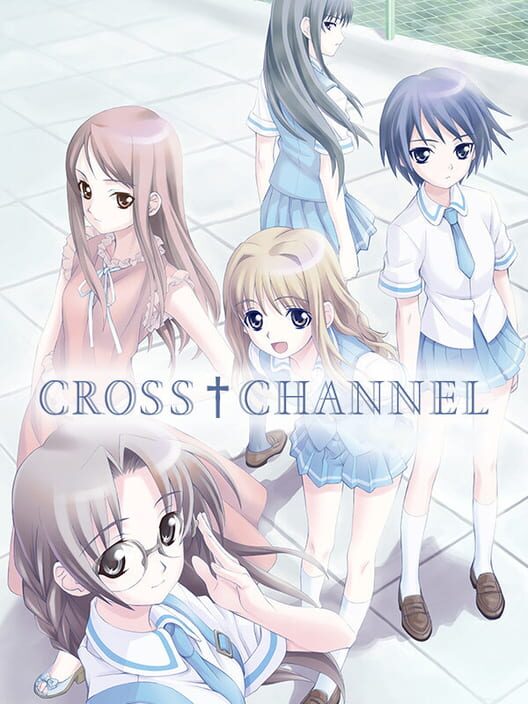
Alright, time to write an actual review of this.
I think trying to play guess with the author's intent leads to very few worthwhile results and within the context of this game this becomes particularly obvious. Cross Channel has had three separate translations of which the first one is noticeably jank while the following two both sport their wealth of issues that make it into an entirely different experience. As many people have noted the game should be ideally experienced by just learning japanese to read the script in its originally invisioned way however that becomes a huge time sink in of itself that will likely take at least a full year of dedicated work to even seem feasible. I am not someone with that kind of time, even if I do plan on doing just that given the opportunity. I played the original Fuwanovel fantranslation and I will not even attempt to claim that doing so is what most experts on the subject would call "the ideal experience". One can read my review as entirely biased in such a way and that extends to my first statement in regards to my thoughts on this game.
Even if it is not ideal, it is quite poetic that a game about people who cannot understand each other despite how hard they try and communicate would be a game with so many translations where the original meaning appears to be lost. That so many people can look at the same text and see their own versions of the story in such striking manner is something I find deeply compelling.
So anyways, I will now give my own thoughts on the game:
One of the reasons I like Cross Channel is that its one of the most empathetic games I have played.
Not necessarily because it cares about its characters, but because its fully dedicated to conveying the emotions of its characters.
And one of its most prominent emotions is pain.
To an extent I rarely see other games go for, Cross Channel is a story that fully dedicates itself to be about how deeply painful it is to be alive.
To pretend like this is the first eroge to be aware of its status as fetishization of misery would be foolish, and so would be trying to deny that Cross Channel is fetishizing its misery. Its a game that is sold commercially and as such allows for you to, in quick reach of the menu screen, watch back the scenes of torture and sexual violence on the same screen you may watch the scenes of consensual sex between two high schoolers. One may interpret this as a bad thing given the game's subject material but I would argue its precisely that degree of fetishization that allows this game to work. The protagonist is not someone simply interested in sex with men or women, the game goes quite in detal on how Taichi is someone who is very into the idea of having sex with girls younger and less experienced than he is. It is not a game afraid to show you that this teenager is himself someone who finds the experience of being a teenager an appeal when pursuing sexual scenarios. It is not just as if Taichi's vision is what colors the presentation of the game, but rather the presentation of the game and what is to be expected of a commercial eroge at the time is used to characterize Taichi by making said genre conventions into the core of his writing. Character designs are thin and border on sickly in some key scenes, colors are muted, everything looks fragile and that is the type of thing that a lot of people who buy this game would be into. Calling it "a critique" of such aspects is only as fruitful as calling Starship Troopers a critique of fascism despite how the same movie goes through great lengths to depict itself as fascist propaganda. Cross Channel, to me at least, has more interest in empathizing with said view more than solely critiquing it. It wants us to see what Taichi, what the game sees and draw our own conclusions on why the game is made like this and why someone would fetishize this experience to this extent. Just as the game analyzes and breaks down the components of its aesthetics, it is easy for the audience to do the same at an even faster pace than the game goes for and as such allows for the game's gradual self-reflection to feel like the payoff to the audience's own analysis.
And it cannot be overstaed how much its pace and length serve to influence the kind of experience Cross Channel is. I cannot speak for the steam release which I have heard fleshes out many of the slice of life scenes to the detriment of the game's deliberate decisions, but I can speak on how the base game uses its 15-20 hour runtime expertly in never allowing a single scene to feel wasted in what the game aims to do. Every small comedy scene serves double duty in informing you on something about these characters that players may not even realize is supposed to be a setup for later plot developments until its too late. Every dramatic scene is carefully spread to keep your intrigue and make sure you have enough time to digest it before the next plot beat arrives. Every calamity that befalls this cast of characters feels as brief as it feels impactful thanks to the game's efforts in maximizing the initial shock of realization and sychronizing it with the pace at which its player advances through the story. And every scene combined makes it so the game becomes hard to put down or look away from even when you find yourself reading through some of the most harrowing depictions of its subject material one can find.
Because this game does not pull punches at any point. Despite what I stated about the game's undeniable fetishization of its subject material, that never stops, or rather it almost enhances its own angles on the way it depicts its characters. The characters in Cross Channel do not feel real simply because they do horrible things, they feel real because the game is not afraid in showcasing how the same people who can do these horrible things can, for the same reasons, commit some of the greatest acts of kindness and self-sacrifice one can imagine all the while staying true to the same deeply flawed thought process that allows them to harm others. And that those same acts of kindness become rarer the more time these people are allowed to know each other, for the more you believe you learn about your fellow man, the easier it becomes to stop trying to understand such person under the impression that you have figured out who they are. And once these characters find themselves believing to have understood each other, that is usually the moment where tragedy strikes at its most sickening.
This is a sickening game, as I would hope so given its subject material. I have seen people play it who feel a fraction of the sickness that the characters presumably feel and that is enough to bring about noticeable change in their behavior. Depending on what kind of person you are, this will likely have no effect on you. And by all metrics, this is not a positive or a negative for the game. I am more sickened by eating poorly prepared ground beef than I was by this game's most arduous segments. But it is something to keep in mind to anyone who would be interested in this kind of game.
Because, if all I've stated above doesn't make it clear, I truly believe this game would not work nearly as well if not for how all of its elements, all of its ugliest parts, come together to create an experience that lives in my mind like few others do. Its a game so laser-focused in delivering a specific kind of hell to any of its players that its what makes it the most cathartic when said hell leads into some of its most elegantly written scenes. More than finding the light at the end of the tunnel, Cross Channel makes you climb the thread out of the netherworld if you want any hope of escape. Its a game that has expanded my horizons in the very way I think about videogames and I hope more people will do so once they find within themselves the will to keep playing through its 15th sex joke. And its 35th. And its 70th. And its 120th. All the way until the end.
One of my favorite games is the korean Danganronpa fangame Danganronpa Another: Another Despair Academy. The game's only available english translation is a machine translation so shoddy it makes most of the dialogue read like the psychological horror segment of a denpa VN meant to showcase the protagonist's insanity. Its a game I deeply wished that it received a proper english translation, regardless of the (un)official remaster that has been in development for years now.
I will probably not find enough reason in my life to take the time and learn korean.
Cross Channel will not be my only reason for learning japanese. I would frankly not feel inclined to do so if it were. But there are countless other works out there which will likely never get a proper translation that I would love to read. And frankly, I don't know how invested I would be on the idea were it not for the fact I read the game's original fantranslation.
A janky, amateurish translation that no doubt required the utmost dedication of the people working on it to even see the light of day. And I am thankful it did, as it allowed me and so many people to experience this text.
To all spiders who have woven the thread out of hell: I hope you realize how much your work means to the humans that would smite you.
I think trying to play guess with the author's intent leads to very few worthwhile results and within the context of this game this becomes particularly obvious. Cross Channel has had three separate translations of which the first one is noticeably jank while the following two both sport their wealth of issues that make it into an entirely different experience. As many people have noted the game should be ideally experienced by just learning japanese to read the script in its originally invisioned way however that becomes a huge time sink in of itself that will likely take at least a full year of dedicated work to even seem feasible. I am not someone with that kind of time, even if I do plan on doing just that given the opportunity. I played the original Fuwanovel fantranslation and I will not even attempt to claim that doing so is what most experts on the subject would call "the ideal experience". One can read my review as entirely biased in such a way and that extends to my first statement in regards to my thoughts on this game.
Even if it is not ideal, it is quite poetic that a game about people who cannot understand each other despite how hard they try and communicate would be a game with so many translations where the original meaning appears to be lost. That so many people can look at the same text and see their own versions of the story in such striking manner is something I find deeply compelling.
So anyways, I will now give my own thoughts on the game:
One of the reasons I like Cross Channel is that its one of the most empathetic games I have played.
Not necessarily because it cares about its characters, but because its fully dedicated to conveying the emotions of its characters.
And one of its most prominent emotions is pain.
To an extent I rarely see other games go for, Cross Channel is a story that fully dedicates itself to be about how deeply painful it is to be alive.
To pretend like this is the first eroge to be aware of its status as fetishization of misery would be foolish, and so would be trying to deny that Cross Channel is fetishizing its misery. Its a game that is sold commercially and as such allows for you to, in quick reach of the menu screen, watch back the scenes of torture and sexual violence on the same screen you may watch the scenes of consensual sex between two high schoolers. One may interpret this as a bad thing given the game's subject material but I would argue its precisely that degree of fetishization that allows this game to work. The protagonist is not someone simply interested in sex with men or women, the game goes quite in detal on how Taichi is someone who is very into the idea of having sex with girls younger and less experienced than he is. It is not a game afraid to show you that this teenager is himself someone who finds the experience of being a teenager an appeal when pursuing sexual scenarios. It is not just as if Taichi's vision is what colors the presentation of the game, but rather the presentation of the game and what is to be expected of a commercial eroge at the time is used to characterize Taichi by making said genre conventions into the core of his writing. Character designs are thin and border on sickly in some key scenes, colors are muted, everything looks fragile and that is the type of thing that a lot of people who buy this game would be into. Calling it "a critique" of such aspects is only as fruitful as calling Starship Troopers a critique of fascism despite how the same movie goes through great lengths to depict itself as fascist propaganda. Cross Channel, to me at least, has more interest in empathizing with said view more than solely critiquing it. It wants us to see what Taichi, what the game sees and draw our own conclusions on why the game is made like this and why someone would fetishize this experience to this extent. Just as the game analyzes and breaks down the components of its aesthetics, it is easy for the audience to do the same at an even faster pace than the game goes for and as such allows for the game's gradual self-reflection to feel like the payoff to the audience's own analysis.
And it cannot be overstaed how much its pace and length serve to influence the kind of experience Cross Channel is. I cannot speak for the steam release which I have heard fleshes out many of the slice of life scenes to the detriment of the game's deliberate decisions, but I can speak on how the base game uses its 15-20 hour runtime expertly in never allowing a single scene to feel wasted in what the game aims to do. Every small comedy scene serves double duty in informing you on something about these characters that players may not even realize is supposed to be a setup for later plot developments until its too late. Every dramatic scene is carefully spread to keep your intrigue and make sure you have enough time to digest it before the next plot beat arrives. Every calamity that befalls this cast of characters feels as brief as it feels impactful thanks to the game's efforts in maximizing the initial shock of realization and sychronizing it with the pace at which its player advances through the story. And every scene combined makes it so the game becomes hard to put down or look away from even when you find yourself reading through some of the most harrowing depictions of its subject material one can find.
Because this game does not pull punches at any point. Despite what I stated about the game's undeniable fetishization of its subject material, that never stops, or rather it almost enhances its own angles on the way it depicts its characters. The characters in Cross Channel do not feel real simply because they do horrible things, they feel real because the game is not afraid in showcasing how the same people who can do these horrible things can, for the same reasons, commit some of the greatest acts of kindness and self-sacrifice one can imagine all the while staying true to the same deeply flawed thought process that allows them to harm others. And that those same acts of kindness become rarer the more time these people are allowed to know each other, for the more you believe you learn about your fellow man, the easier it becomes to stop trying to understand such person under the impression that you have figured out who they are. And once these characters find themselves believing to have understood each other, that is usually the moment where tragedy strikes at its most sickening.
This is a sickening game, as I would hope so given its subject material. I have seen people play it who feel a fraction of the sickness that the characters presumably feel and that is enough to bring about noticeable change in their behavior. Depending on what kind of person you are, this will likely have no effect on you. And by all metrics, this is not a positive or a negative for the game. I am more sickened by eating poorly prepared ground beef than I was by this game's most arduous segments. But it is something to keep in mind to anyone who would be interested in this kind of game.
Because, if all I've stated above doesn't make it clear, I truly believe this game would not work nearly as well if not for how all of its elements, all of its ugliest parts, come together to create an experience that lives in my mind like few others do. Its a game so laser-focused in delivering a specific kind of hell to any of its players that its what makes it the most cathartic when said hell leads into some of its most elegantly written scenes. More than finding the light at the end of the tunnel, Cross Channel makes you climb the thread out of the netherworld if you want any hope of escape. Its a game that has expanded my horizons in the very way I think about videogames and I hope more people will do so once they find within themselves the will to keep playing through its 15th sex joke. And its 35th. And its 70th. And its 120th. All the way until the end.
One of my favorite games is the korean Danganronpa fangame Danganronpa Another: Another Despair Academy. The game's only available english translation is a machine translation so shoddy it makes most of the dialogue read like the psychological horror segment of a denpa VN meant to showcase the protagonist's insanity. Its a game I deeply wished that it received a proper english translation, regardless of the (un)official remaster that has been in development for years now.
I will probably not find enough reason in my life to take the time and learn korean.
Cross Channel will not be my only reason for learning japanese. I would frankly not feel inclined to do so if it were. But there are countless other works out there which will likely never get a proper translation that I would love to read. And frankly, I don't know how invested I would be on the idea were it not for the fact I read the game's original fantranslation.
A janky, amateurish translation that no doubt required the utmost dedication of the people working on it to even see the light of day. And I am thankful it did, as it allowed me and so many people to experience this text.
To all spiders who have woven the thread out of hell: I hope you realize how much your work means to the humans that would smite you.
Umineko When They Cry (2010 - 2011)
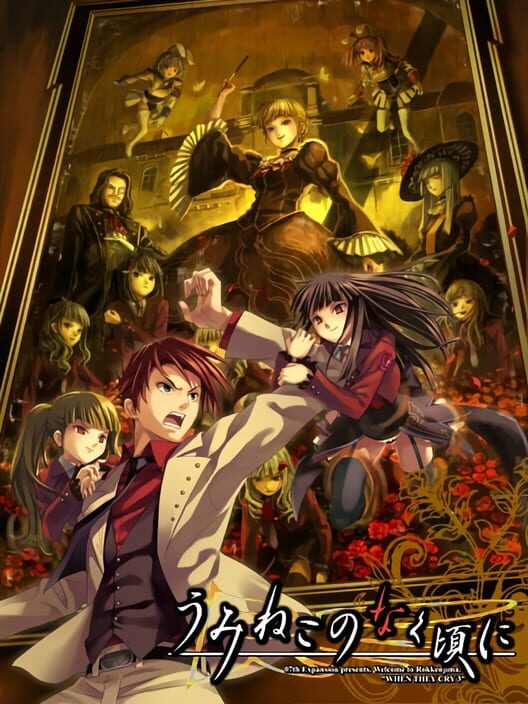
They say the opposite of love is not hate, but apathy, as strong hatred
for something still means you think about it so much that it can be
interpreted as a form of love. I get the sentiment, but I would frame it
in another way: "Love" is obsession. Its gluttony. The desire to
consume and absorb something for yourself and enjoy the thing you love
so dear. To feast upon it and feel a sense of fulfilment from the thing
that completes you. Apathy is deemed the opposite of love because to be
apathetic is to not care about something, while to love is to desire it
and have that desire consume you. From my experience, love is a monster,
it makes people do atrocities and lets them justify it under pretty
words. It drives people to self-destruction and they romanticize it so
they don't have to deal with the reality of what they did. It is a
corruption that eats away at everything until there is nothing left but
the carcass of what it once was. All for the sake of love. I have loved
things before, I still do, so I am no different.
I say all of this as, truth be told, I more or less knew going in that there was very little I would get out of this game.
Because without love, it cannot be seen.
Umineko no Naku Koro ni is a game where what you think of it will likely be predicated on two factors:
1 - On whether or not have you seen other works that tackle the ideas in Umineko.
2 - How do you feel about the ideas Umineko tackles as they reflect on your own experience.
Depending on your answers to these questions the experience Umineko is will be vastly different. Many people have had their lives changed by Umineko and in all honesty I am very glad that is the case, they managed to get a positive interpretation out of the work and anything that has a positive impact on one's life is something that I give credit for. The last thing I want to say is that the people who have had the game impact them in a positive way are in the wrong for defining the truth as their own.
No, what I want to say is not that Umineko cannot change lives or that its bad. Its that Umineko's ability to change lives is equal to that of any piece of fiction. Just as people may have their lives turned around by being big fans of things like the Harry Potter novels, regardless of their content or creator, people may grow a strong attatchment to Umineko, as what will pull them in will not necessarily be the work itself, but the experience they have with the work. People who are fans of Harry Potter rarely are fans of it because of the racist libertarian undertones, its because the story that they created in their heads based on these books managed to leave an impression on them and that story may not reflect the same problematic elements that the original text has, as those elements of the text are not active parts of the narrative. The same applies to fandom. What becomes part of one's understanding of a work, and even the quality of said work, is more often than not dictated by the narrative that people try to portray as they frame their experience and feelings surrounding said work under the guise of their opinions on the work in of itself.
Umineko, like any other piece of fiction, will only be loved by people who want to love it.
Because love is a gluttonous beast, and it will seek to consume to satisfy itself. As long as it sees something that is appetizing, it will be devoured. And the love will be satisfied with absorbing the story that looked oh so delicious.
Umineko is a story about a woman who loved.
Her love is beautiful, and the story will make sure to remind you of that. Beatrice's Golden Land is a paradise where all are free to be happy and enjoy the rest of their days in a world where their mortalities are trivial and they play endless games of endless mysteries that dare to be solved by their reader. But you may ask, isn't the mortality of the pieces and the lives of the people in the gameboard something that is as valuable as the real deal? After all, the first few episodes make sure to remind us that yes, they may be in the Golden Land where they are immortal and happy, but that happiness only persists as long as they praise and dedicate their names to the Golden Witch who rules this world. For the Golden Land is hers by design. This lines up with what we eventually learn about her, or rather what we don't. Its a point of contention among the fanbase, as the additional information given in the manga, while perfectly abiding by what the game implies, is seen as a violation of the witch's privacy, a break in the illusion that goes against the themes of the story. And why is that? Because Sayo Yasuda does not want people to look at her. She sees herself as ugly, a monster, furniture incapable of love with weird incestuous feelings that is cursed for a horrible existence. The story, as presented by her, is that of the tragedy of a young woman who was isolated by her peers and grew to believe in magic as a way to populate her world, to feel a sense of empowerement while being made to work as a servant, eventually developing multiple personas so that she could live out her fantasies of romance with the many members of the Ushiromiya family, unaware that she herself was one of the members. Thus, upon realizing the truth and being gifted the authority of the Golden Land, she becomes the Golden Witch Beatrice who sets out to create an endless chain of murders with the expectation she will be stopped by her one unrequited love, her prince in a white horse, Ushiromiya Battler. The one who promised to come for her when she needed most.
Put another way, Sayo Yasuda is an incel who could not get over the boy who made a promise on a certain day, based her entire personality around conforming to the misoginystic standards that she was raised in, and when made to confront that she actually had way more authority and responsibility then she was led to believe living her life as a servant, and that all the people she had been leading love lifes with in a masquerade as to satisfy the hunger of her own love were actually her siblings, eventually snapped and decided to conoct a mass murder plan that would ultimately culminate with her suicide unless her promised lover were to stop her. In that sense, it makes perfect sense as to why the Golden Land is framed that way, as it is a perfect realm where all expectations promised to you are delivered. Where all will praise you for who you are, regardless on wether or not you were unloved by the people around you in your life. For you are the almighty powerful Golden Witch Beatrice, who despite being a cackling mass murderous villain is also deeply sentimental and romantic. A tragic figure, as the narrative will keep reminding you. Someone who has no blame over any of the things that happened. Someone who had no choice but to do all of this and even so did not actually do any of it. Its not as if she was responsible for setting up the entire scenario which led to everyone's deaths or something of the sort, after all, she is just a poor victim who never manipulated anyone. She is just a sad little girl who couldn't do anything. She was just a riddle that was waiting to be answered, not the one who weaved riddles expecting people to answer them.
What I describe above, as you can tell, is not how Umineko sees Sayo Yasuda. I would argue it is the character that is written within the text, but that in of itself is merely my interpretation, the story I connocted based on the words I took out of the text. So it could be argue that I could simply interpret things in another way to look at her character more favorably, which I have tried to, only to be met with the large incongruity that is made in the process. Umineko wants Beatrice to both be seen as a tragic heroine and a genious villain figure at different points in the narrative and it never truly consolidates both into a consistent character. In order to make her into a tragic heroine it has to basically ignore or outright contradict many of the earlier elements of her characterization for the sake of painting her in a more sympathetic light, resulting in a story that seems to not decide on the basic rules of its universe as to wether or not the pieces on the game board are just sock puppets or people with full autonomy, as you may be lead to believe by the piece of Ushiromiya Battler gaining self awareness in Episode 1 and becoming the player in the game board for future Episodes. The story will not dwell on the implication Beatrice is torturing living people for her own amusement after this as doing so would contradict the heart of what it tries to say.
She is an incongrous character and that is mainly born as a result of Umineko downright refusing to ever portray her in a negative light as to not engage with its audience on the level of studying why a character like this would get to the position that we see in the game. It comes across as insincere and hollow in its attempts to humanize her as it tries to portray her as an innocent angel rather than the person we are led to believe from the early arcs. What is ultimately a tragedy as a character that I think is potentially very interesting ends up buried within a story that tries to cover it up as much as possible. In truth, I think in an ideal world Confessions of the Golden Witch would not need to exist, the story should allow you to understand what kind of character Sayo is even without its inclusion, yet Umineko as a story is so deadset on covering her tracks that it will erase her own personality, just as she wishes, in hopes that people will see her and form a cult around her as a god just as she dreamed of. Umineko is propaganda for her cause, and there is a character that must be discussed if we are to talk about it.
Umineko is a story about a man who loved.
Battler Ushiromiya is presented at the start of the story to be a hot blooded, albeit foolish man who is dragged into solving a mystery despite his determination to not see any of his family members as bad people. This is a trait that is consistent with his character as he spends Episode after Episode chasing after the witch and trying to disprove her existence as he refuses to see a world in which everyone's deaths is ruled out by a magical mishap, yet refuses just as much to see any of his family members whom he cherishes as the culprit. A cognitive dissonance that builds up and ultimately culminates in him recognizing the witch as a method to diver the guilt from anyone in Rokkenjima, and thus her inevitable defeat by his hands as the inevitable moment where he must answer who she is, who is the culprit behind all these tragedies, a moment that forces him to reconsider wether or not he desires to give a solution to this mystery.
But this is only part of his character, the part that we are presented it for the game's first four arcs. As after that, Battler is much more prominently written to be something else.
Battler Ushiromiya, the avid reader of mystery novels.
A somewhat comedic, yet incredibly skilled master at solving and formulating mysteries that is able to outwit most of the other entities in the story by using his knowledge of the times he spent reading novels in order to showcase how his superior, love-fueled view of the world trumps that of those who only read these books for their own amusement. For he sees the story as it is meant to be seen, and as such can use the golden truth and define those terms in a way that goes beyond even that of what should be the commonly understood interpretation. Its not about the text, after all, not about the actions that are reflected within the story, but rather about what the intent behind them is. Those who obsess over said actions being nothing more than irrational, simple-minded intellectual rapists who will get wrong the very facts and basis of the mystery novels they claim to be fans of. As the story proves not only with the character of Battler, but by puppeteering the corpse of S.S. Van Dine under his real name so that it may give the thesis about mystery novels that the story is trying to prove. An act that is presented completely unironically by the narrative in which is framed, despite its discussions about defiling the corpse of the witch in the same Episode.
This is important as this all culminates into a further examination of another, and by that I mean the same character: Hachijo Tohya, the mastermind, and by that I mean tragic victim behind most of the events we have seen in the story. A man who could not confront his past and as a result isolated himself for years upon years just writing and rewriting stories surrounding the catbox in hopes of reaching the heart of the story, a struggle that he reflects on the way he writes Battler within the metaworld narrative. Tohya is a man trapped by the fact that he cannot let go of the mistakes of his former self, yet does not want to confront them as to face reality, that being the reason why he refuses to publicly come out and instead spends time writing the forgeries within the catbox. In which case, it becomes very interesting how Tohya seems to make many deliberate choices in his writing of previous episodes. Such as taking Erika Furudo, the real girl in this world who went missing that night and presumably died and making her into a psychotic rapist who is deeply in love with his former self. The twist of Tohya writing Episodes 3-6 is something that recontextualizes nearly everything you see in these episodes, but rather than making it satisfactory it ends up painting the image of Tohya as this unhinged man who will make all of the people in his life into public sock puppets for whatever he's dealing with. Which is important given how this retroactively makes it so Battler's behavior in these episodes, and in later episodes with context of him having learned the truth, shifts as he becomes incredibly callous and insensitive to many of the people who are still alive. Most notably in the reveal of Episode 8 where he just leaves Eva on the island and does not even bother to check wether or not she's dead before going off with Beatrice into the sea, thus inadvertendly framing a woman for all the crimes that were comitted there. Its a detail that makes the scene of Beatrice's suicide and Battler's eventual fall which is meant to be read as tragic and romantic instead come across as rather comedic when you remember they just left a woman to take the blame for all of this and tried to run away.
But of course, if we are to talk about Eva, we must also talk about the other person who Battler leaves behind.
Umineko is a story about a child who was loved.
Ange Ushiromiya is a girl who spent most of her life being abused by Eva Ushiromiya, something that came after Eva got tired of hearing Ange blame her for everything and in turn led Eva to start making Ange's life as miserable as possible in revenge. Disregarding how weird it is that Eva at no point tries to come out with the truth of Kyrie being the culprit behind the Rokkenjima Massacre if she wants Ange to suffer so much, specially given that is already an ongoing investigation, the most important aspect of this ends up being on how this is examined within the narrative. Umineko is very open on putting the blame on Ange for her incapacity to comprehend or love her abuser. Just as it is very open about how victims are to blame if the abusers are to act against them. It is seen with how Maria's denial of her abuse and desire to keep only good memories is portrayed as heroic and the right thing to do in this scenario, with Ange's constant reminder of Rosa's mistreatment of her being showcased as her incapacity to let go of the past, not unlike Kyrie's sister who is driven by her hatred of Kyrie. From the get go they set Ange's arc up to be that she must let go of her hatred, of her anger at Eva for imprisoning and mistreating her her whole life, and find her own reason to live. Something she does in Episode 4. And proceeds to do again for the Answers Arc, as she is now forced to confront the consequences of finding the truth. After all, as hinted during the previous episodes, she is secretly deeply suicidal and is planning on ending her life as soon as she obtains the resolution of the mystery of her family's death. For that reason, Battler in the meta world continues to lie and gaslight her into believing everything is fine up until Bernkastel forces her to confront the worse possibilities, thus leading into her brief rebirth as a Witch of Truth and eventual downfall upon reading the text of Eva's journal, ultimately culminating in her taking her experiences and deciding to give all of the wealth that caused this entire conflict to the armed mercenary group that has attempted to kill her multiple times in the past. After all, her best way to contribute to the world is if she continues to carry on the same stories of love that Maria once recorded in her diary. Spreading the tale of Sakutarou until he becomes a beloved children's icon, even as Ange is left in her old age slowly dying of cancer under a pseudonym. She has now devoted her life to spreading the truth that she developed from her experience in the metaverse, a truth of a happy world, building an orphanage that honors the Ushiromiya manor and hangs the portrait of Beatrice, the legendary witch behind their legacy, proud for the world to see.
However, even that is less about Ange. In those moments, its not in Ange's reaction that it focuses. Her accomplishments have instead another goal.
To fuel Tohya's motivation. To give a conclusion to his character arc.
Just as every part of Ange's plotline is almost always presented under the reference of Battler. In Episode 4, her storyline is building up to her having her tragic sacrifice as she saves Battler from falling into despair. In Episode 8, the conclusion of her character arc as she comes to obtain the golden truth is ultimately building up to what serves as Tohya's big moment and reveal. Battler not being dead is not a triumph of her vision of Battler's spirit living on, but rather a technicality as Tohya had continued to exist, just as the entire mystery is foundated on the technicality of Kanon and Shanon's misleading "death" red truths. Ange is always an object for Battler's arc. As all women in Umineko are ultimately treated as objects for the men in their lives, and portrayed as evil when they do not conform to these roles. Something best seen with Kyrie, as the portrayal of an incredibly jealous gold digger motivated only by her career and greed is tied hand in hand with her being by far the most individualist woman of the core cast and the most dominant one in the relationship compared to Rudolph. Intentionally or not, her writing ends up reflecting many of the mysoginist stereotypes surrounding women who aim to attain success in their lives. This, of course, extending to the treatment of Ange at the end. Someone whose best possible future is potrayed as one where she dedicates her life taking care of children and telling them stories as opposed to the Trick Ending, in which she and Erika Furudo, another woman with agency portrayed as evil within the story, sail off to find the truth together after shooting down the people in the boat.
But of course, this builds to one of the final thinkpieces I present in this post.
Umineko is a story about a reader in love.
Umineko is centered around fiction, the discussion of fiction, and the impact fiction has on people's lives. And, most importantly, how one must define their truth from fiction.
It is so baffling then that Umineko spends so much of its time claiming how there is one objective way you should look at its story.
It will not tell you who the culprit is, that would be disrespectful to their wishes, so instead it will continuously hint at it to the point of exhaustion without ever aknowledging it in the text.
It will not openly say those who criticize the story as a mystery are wrong, in fact it will go out of its way to use the sock puppet of S.S. Van Dine to talk about how you should look at mysteries (in ways that contradict what the real Van Dine had to say on the subject matter). But it will create figures meant to represent the real life online critics of Umineko as a work and portray them as mindless goats who only parrot the opinions of others. Comparing them to people who are defiling the memory of real-life victims of tragedies.
It will not openly say it thinks of its readers as idiotic. But it will have a character under the role of author who says many of the themes you are supposed to take from the story as matter of fact openly talk about most of the fans dont get what their work is about and only a few of them will actually understand.
My biggest takeaway, ultimately, ended up being that despite its constant claims about love, Umineko at its core is one of the most meanspirited works I have read. Its a work that seems filled with spite torwards many of its characters and subject matters while disguised under the guise of trying to lecture the reader. And the reader is conditioned into seeing the contempt of the work as a form of love in of itself. That is ultimately the purpose of characters like Erika and Bernkastel, caricatures made of the collective thoughts and opinions of others and portrayed as comically evil villains akin to social media comics meant to get a following. Catchphrases that make it easy for fans to dismiss criticism of the work as "bad faith readings" of the source material once they arrive at interpretrations that do not align with the accepted canon. Fandom discourse is not something I ever find worth getting into when analyzing a work, yet its hard to separate it from Umineko given how it was an influence within the work in of itself. And how, as a response to fandom, Umineko was a work made by the author with the clear intent of influencing its fanbase back. Something that has been taken in stride in defenses of the subject.
My Umineko is a story without love.
I do not think about what would be a version of Umineko that I enjoyed. Because beforehand I had already experienced multiple works which tackled similar topics as Umineko and I held dear to my heart.
So when I played Umineko, it was not impressive to me that many of these ideas were presented to begin with, not as I imagine it must have been to a lot of its fans. In fact, the sloppy way in which it attempts to explain many of its ideas is what makes me glad that so many fans seem to develop out of that and into writing things that handle many of these topics in ways I enjoy way more.
However, for my personal experience, there was still very little to enjoy. There was very little for me to consume as gluttonous monster that wasn't the same food I'd had in other places. The unique qualities it had were so baffling that they only somewhat managed to be enjoyable. More than anything, Umineko to me felt like someone's misguided attempt at proving something rather than attempting to be honest about what it truly wants to say.
But I can see why people like Umineko. So in that sense, I suppose I have love.
I say all of this as, truth be told, I more or less knew going in that there was very little I would get out of this game.
Because without love, it cannot be seen.
Umineko no Naku Koro ni is a game where what you think of it will likely be predicated on two factors:
1 - On whether or not have you seen other works that tackle the ideas in Umineko.
2 - How do you feel about the ideas Umineko tackles as they reflect on your own experience.
Depending on your answers to these questions the experience Umineko is will be vastly different. Many people have had their lives changed by Umineko and in all honesty I am very glad that is the case, they managed to get a positive interpretation out of the work and anything that has a positive impact on one's life is something that I give credit for. The last thing I want to say is that the people who have had the game impact them in a positive way are in the wrong for defining the truth as their own.
No, what I want to say is not that Umineko cannot change lives or that its bad. Its that Umineko's ability to change lives is equal to that of any piece of fiction. Just as people may have their lives turned around by being big fans of things like the Harry Potter novels, regardless of their content or creator, people may grow a strong attatchment to Umineko, as what will pull them in will not necessarily be the work itself, but the experience they have with the work. People who are fans of Harry Potter rarely are fans of it because of the racist libertarian undertones, its because the story that they created in their heads based on these books managed to leave an impression on them and that story may not reflect the same problematic elements that the original text has, as those elements of the text are not active parts of the narrative. The same applies to fandom. What becomes part of one's understanding of a work, and even the quality of said work, is more often than not dictated by the narrative that people try to portray as they frame their experience and feelings surrounding said work under the guise of their opinions on the work in of itself.
Umineko, like any other piece of fiction, will only be loved by people who want to love it.
Because love is a gluttonous beast, and it will seek to consume to satisfy itself. As long as it sees something that is appetizing, it will be devoured. And the love will be satisfied with absorbing the story that looked oh so delicious.
Umineko is a story about a woman who loved.
Her love is beautiful, and the story will make sure to remind you of that. Beatrice's Golden Land is a paradise where all are free to be happy and enjoy the rest of their days in a world where their mortalities are trivial and they play endless games of endless mysteries that dare to be solved by their reader. But you may ask, isn't the mortality of the pieces and the lives of the people in the gameboard something that is as valuable as the real deal? After all, the first few episodes make sure to remind us that yes, they may be in the Golden Land where they are immortal and happy, but that happiness only persists as long as they praise and dedicate their names to the Golden Witch who rules this world. For the Golden Land is hers by design. This lines up with what we eventually learn about her, or rather what we don't. Its a point of contention among the fanbase, as the additional information given in the manga, while perfectly abiding by what the game implies, is seen as a violation of the witch's privacy, a break in the illusion that goes against the themes of the story. And why is that? Because Sayo Yasuda does not want people to look at her. She sees herself as ugly, a monster, furniture incapable of love with weird incestuous feelings that is cursed for a horrible existence. The story, as presented by her, is that of the tragedy of a young woman who was isolated by her peers and grew to believe in magic as a way to populate her world, to feel a sense of empowerement while being made to work as a servant, eventually developing multiple personas so that she could live out her fantasies of romance with the many members of the Ushiromiya family, unaware that she herself was one of the members. Thus, upon realizing the truth and being gifted the authority of the Golden Land, she becomes the Golden Witch Beatrice who sets out to create an endless chain of murders with the expectation she will be stopped by her one unrequited love, her prince in a white horse, Ushiromiya Battler. The one who promised to come for her when she needed most.
Put another way, Sayo Yasuda is an incel who could not get over the boy who made a promise on a certain day, based her entire personality around conforming to the misoginystic standards that she was raised in, and when made to confront that she actually had way more authority and responsibility then she was led to believe living her life as a servant, and that all the people she had been leading love lifes with in a masquerade as to satisfy the hunger of her own love were actually her siblings, eventually snapped and decided to conoct a mass murder plan that would ultimately culminate with her suicide unless her promised lover were to stop her. In that sense, it makes perfect sense as to why the Golden Land is framed that way, as it is a perfect realm where all expectations promised to you are delivered. Where all will praise you for who you are, regardless on wether or not you were unloved by the people around you in your life. For you are the almighty powerful Golden Witch Beatrice, who despite being a cackling mass murderous villain is also deeply sentimental and romantic. A tragic figure, as the narrative will keep reminding you. Someone who has no blame over any of the things that happened. Someone who had no choice but to do all of this and even so did not actually do any of it. Its not as if she was responsible for setting up the entire scenario which led to everyone's deaths or something of the sort, after all, she is just a poor victim who never manipulated anyone. She is just a sad little girl who couldn't do anything. She was just a riddle that was waiting to be answered, not the one who weaved riddles expecting people to answer them.
What I describe above, as you can tell, is not how Umineko sees Sayo Yasuda. I would argue it is the character that is written within the text, but that in of itself is merely my interpretation, the story I connocted based on the words I took out of the text. So it could be argue that I could simply interpret things in another way to look at her character more favorably, which I have tried to, only to be met with the large incongruity that is made in the process. Umineko wants Beatrice to both be seen as a tragic heroine and a genious villain figure at different points in the narrative and it never truly consolidates both into a consistent character. In order to make her into a tragic heroine it has to basically ignore or outright contradict many of the earlier elements of her characterization for the sake of painting her in a more sympathetic light, resulting in a story that seems to not decide on the basic rules of its universe as to wether or not the pieces on the game board are just sock puppets or people with full autonomy, as you may be lead to believe by the piece of Ushiromiya Battler gaining self awareness in Episode 1 and becoming the player in the game board for future Episodes. The story will not dwell on the implication Beatrice is torturing living people for her own amusement after this as doing so would contradict the heart of what it tries to say.
She is an incongrous character and that is mainly born as a result of Umineko downright refusing to ever portray her in a negative light as to not engage with its audience on the level of studying why a character like this would get to the position that we see in the game. It comes across as insincere and hollow in its attempts to humanize her as it tries to portray her as an innocent angel rather than the person we are led to believe from the early arcs. What is ultimately a tragedy as a character that I think is potentially very interesting ends up buried within a story that tries to cover it up as much as possible. In truth, I think in an ideal world Confessions of the Golden Witch would not need to exist, the story should allow you to understand what kind of character Sayo is even without its inclusion, yet Umineko as a story is so deadset on covering her tracks that it will erase her own personality, just as she wishes, in hopes that people will see her and form a cult around her as a god just as she dreamed of. Umineko is propaganda for her cause, and there is a character that must be discussed if we are to talk about it.
Umineko is a story about a man who loved.
Battler Ushiromiya is presented at the start of the story to be a hot blooded, albeit foolish man who is dragged into solving a mystery despite his determination to not see any of his family members as bad people. This is a trait that is consistent with his character as he spends Episode after Episode chasing after the witch and trying to disprove her existence as he refuses to see a world in which everyone's deaths is ruled out by a magical mishap, yet refuses just as much to see any of his family members whom he cherishes as the culprit. A cognitive dissonance that builds up and ultimately culminates in him recognizing the witch as a method to diver the guilt from anyone in Rokkenjima, and thus her inevitable defeat by his hands as the inevitable moment where he must answer who she is, who is the culprit behind all these tragedies, a moment that forces him to reconsider wether or not he desires to give a solution to this mystery.
But this is only part of his character, the part that we are presented it for the game's first four arcs. As after that, Battler is much more prominently written to be something else.
Battler Ushiromiya, the avid reader of mystery novels.
A somewhat comedic, yet incredibly skilled master at solving and formulating mysteries that is able to outwit most of the other entities in the story by using his knowledge of the times he spent reading novels in order to showcase how his superior, love-fueled view of the world trumps that of those who only read these books for their own amusement. For he sees the story as it is meant to be seen, and as such can use the golden truth and define those terms in a way that goes beyond even that of what should be the commonly understood interpretation. Its not about the text, after all, not about the actions that are reflected within the story, but rather about what the intent behind them is. Those who obsess over said actions being nothing more than irrational, simple-minded intellectual rapists who will get wrong the very facts and basis of the mystery novels they claim to be fans of. As the story proves not only with the character of Battler, but by puppeteering the corpse of S.S. Van Dine under his real name so that it may give the thesis about mystery novels that the story is trying to prove. An act that is presented completely unironically by the narrative in which is framed, despite its discussions about defiling the corpse of the witch in the same Episode.
This is important as this all culminates into a further examination of another, and by that I mean the same character: Hachijo Tohya, the mastermind, and by that I mean tragic victim behind most of the events we have seen in the story. A man who could not confront his past and as a result isolated himself for years upon years just writing and rewriting stories surrounding the catbox in hopes of reaching the heart of the story, a struggle that he reflects on the way he writes Battler within the metaworld narrative. Tohya is a man trapped by the fact that he cannot let go of the mistakes of his former self, yet does not want to confront them as to face reality, that being the reason why he refuses to publicly come out and instead spends time writing the forgeries within the catbox. In which case, it becomes very interesting how Tohya seems to make many deliberate choices in his writing of previous episodes. Such as taking Erika Furudo, the real girl in this world who went missing that night and presumably died and making her into a psychotic rapist who is deeply in love with his former self. The twist of Tohya writing Episodes 3-6 is something that recontextualizes nearly everything you see in these episodes, but rather than making it satisfactory it ends up painting the image of Tohya as this unhinged man who will make all of the people in his life into public sock puppets for whatever he's dealing with. Which is important given how this retroactively makes it so Battler's behavior in these episodes, and in later episodes with context of him having learned the truth, shifts as he becomes incredibly callous and insensitive to many of the people who are still alive. Most notably in the reveal of Episode 8 where he just leaves Eva on the island and does not even bother to check wether or not she's dead before going off with Beatrice into the sea, thus inadvertendly framing a woman for all the crimes that were comitted there. Its a detail that makes the scene of Beatrice's suicide and Battler's eventual fall which is meant to be read as tragic and romantic instead come across as rather comedic when you remember they just left a woman to take the blame for all of this and tried to run away.
But of course, if we are to talk about Eva, we must also talk about the other person who Battler leaves behind.
Umineko is a story about a child who was loved.
Ange Ushiromiya is a girl who spent most of her life being abused by Eva Ushiromiya, something that came after Eva got tired of hearing Ange blame her for everything and in turn led Eva to start making Ange's life as miserable as possible in revenge. Disregarding how weird it is that Eva at no point tries to come out with the truth of Kyrie being the culprit behind the Rokkenjima Massacre if she wants Ange to suffer so much, specially given that is already an ongoing investigation, the most important aspect of this ends up being on how this is examined within the narrative. Umineko is very open on putting the blame on Ange for her incapacity to comprehend or love her abuser. Just as it is very open about how victims are to blame if the abusers are to act against them. It is seen with how Maria's denial of her abuse and desire to keep only good memories is portrayed as heroic and the right thing to do in this scenario, with Ange's constant reminder of Rosa's mistreatment of her being showcased as her incapacity to let go of the past, not unlike Kyrie's sister who is driven by her hatred of Kyrie. From the get go they set Ange's arc up to be that she must let go of her hatred, of her anger at Eva for imprisoning and mistreating her her whole life, and find her own reason to live. Something she does in Episode 4. And proceeds to do again for the Answers Arc, as she is now forced to confront the consequences of finding the truth. After all, as hinted during the previous episodes, she is secretly deeply suicidal and is planning on ending her life as soon as she obtains the resolution of the mystery of her family's death. For that reason, Battler in the meta world continues to lie and gaslight her into believing everything is fine up until Bernkastel forces her to confront the worse possibilities, thus leading into her brief rebirth as a Witch of Truth and eventual downfall upon reading the text of Eva's journal, ultimately culminating in her taking her experiences and deciding to give all of the wealth that caused this entire conflict to the armed mercenary group that has attempted to kill her multiple times in the past. After all, her best way to contribute to the world is if she continues to carry on the same stories of love that Maria once recorded in her diary. Spreading the tale of Sakutarou until he becomes a beloved children's icon, even as Ange is left in her old age slowly dying of cancer under a pseudonym. She has now devoted her life to spreading the truth that she developed from her experience in the metaverse, a truth of a happy world, building an orphanage that honors the Ushiromiya manor and hangs the portrait of Beatrice, the legendary witch behind their legacy, proud for the world to see.
However, even that is less about Ange. In those moments, its not in Ange's reaction that it focuses. Her accomplishments have instead another goal.
To fuel Tohya's motivation. To give a conclusion to his character arc.
Just as every part of Ange's plotline is almost always presented under the reference of Battler. In Episode 4, her storyline is building up to her having her tragic sacrifice as she saves Battler from falling into despair. In Episode 8, the conclusion of her character arc as she comes to obtain the golden truth is ultimately building up to what serves as Tohya's big moment and reveal. Battler not being dead is not a triumph of her vision of Battler's spirit living on, but rather a technicality as Tohya had continued to exist, just as the entire mystery is foundated on the technicality of Kanon and Shanon's misleading "death" red truths. Ange is always an object for Battler's arc. As all women in Umineko are ultimately treated as objects for the men in their lives, and portrayed as evil when they do not conform to these roles. Something best seen with Kyrie, as the portrayal of an incredibly jealous gold digger motivated only by her career and greed is tied hand in hand with her being by far the most individualist woman of the core cast and the most dominant one in the relationship compared to Rudolph. Intentionally or not, her writing ends up reflecting many of the mysoginist stereotypes surrounding women who aim to attain success in their lives. This, of course, extending to the treatment of Ange at the end. Someone whose best possible future is potrayed as one where she dedicates her life taking care of children and telling them stories as opposed to the Trick Ending, in which she and Erika Furudo, another woman with agency portrayed as evil within the story, sail off to find the truth together after shooting down the people in the boat.
But of course, this builds to one of the final thinkpieces I present in this post.
Umineko is a story about a reader in love.
Umineko is centered around fiction, the discussion of fiction, and the impact fiction has on people's lives. And, most importantly, how one must define their truth from fiction.
It is so baffling then that Umineko spends so much of its time claiming how there is one objective way you should look at its story.
It will not tell you who the culprit is, that would be disrespectful to their wishes, so instead it will continuously hint at it to the point of exhaustion without ever aknowledging it in the text.
It will not openly say those who criticize the story as a mystery are wrong, in fact it will go out of its way to use the sock puppet of S.S. Van Dine to talk about how you should look at mysteries (in ways that contradict what the real Van Dine had to say on the subject matter). But it will create figures meant to represent the real life online critics of Umineko as a work and portray them as mindless goats who only parrot the opinions of others. Comparing them to people who are defiling the memory of real-life victims of tragedies.
It will not openly say it thinks of its readers as idiotic. But it will have a character under the role of author who says many of the themes you are supposed to take from the story as matter of fact openly talk about most of the fans dont get what their work is about and only a few of them will actually understand.
My biggest takeaway, ultimately, ended up being that despite its constant claims about love, Umineko at its core is one of the most meanspirited works I have read. Its a work that seems filled with spite torwards many of its characters and subject matters while disguised under the guise of trying to lecture the reader. And the reader is conditioned into seeing the contempt of the work as a form of love in of itself. That is ultimately the purpose of characters like Erika and Bernkastel, caricatures made of the collective thoughts and opinions of others and portrayed as comically evil villains akin to social media comics meant to get a following. Catchphrases that make it easy for fans to dismiss criticism of the work as "bad faith readings" of the source material once they arrive at interpretrations that do not align with the accepted canon. Fandom discourse is not something I ever find worth getting into when analyzing a work, yet its hard to separate it from Umineko given how it was an influence within the work in of itself. And how, as a response to fandom, Umineko was a work made by the author with the clear intent of influencing its fanbase back. Something that has been taken in stride in defenses of the subject.
My Umineko is a story without love.
I do not think about what would be a version of Umineko that I enjoyed. Because beforehand I had already experienced multiple works which tackled similar topics as Umineko and I held dear to my heart.
So when I played Umineko, it was not impressive to me that many of these ideas were presented to begin with, not as I imagine it must have been to a lot of its fans. In fact, the sloppy way in which it attempts to explain many of its ideas is what makes me glad that so many fans seem to develop out of that and into writing things that handle many of these topics in ways I enjoy way more.
However, for my personal experience, there was still very little to enjoy. There was very little for me to consume as gluttonous monster that wasn't the same food I'd had in other places. The unique qualities it had were so baffling that they only somewhat managed to be enjoyable. More than anything, Umineko to me felt like someone's misguided attempt at proving something rather than attempting to be honest about what it truly wants to say.
But I can see why people like Umineko. So in that sense, I suppose I have love.


Nenhum comentário:
Postar um comentário